What Is Average Position and When It Misleads You
Average position is a blunt SEO metric that often hides the truth about your rankings. Learn why the math of averages can...
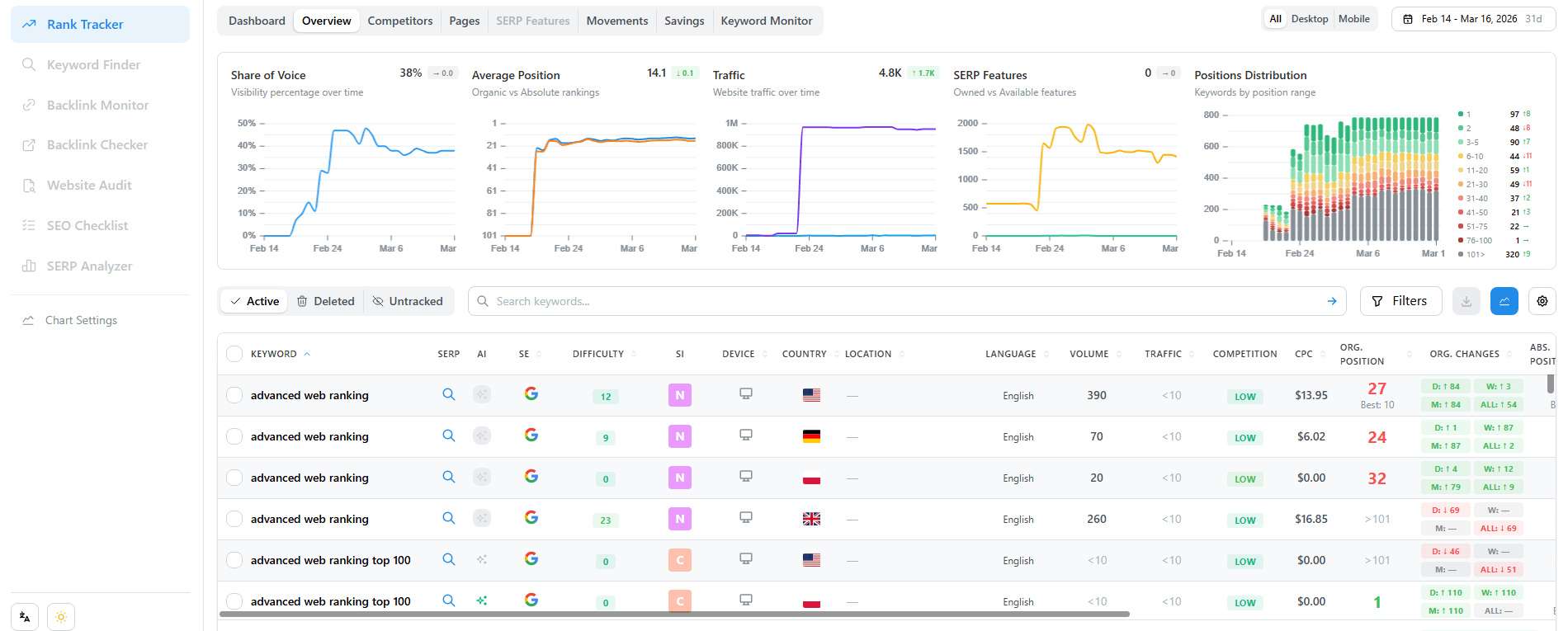
Track search engine rankings with clearer visibility into position changes, SERP placement, page performance, and keyword movement across locations and devices. Built for people who need ranking insight that leads to practical SEO decisions.
When positions change, you need more than a number. You need to know which keywords moved, which pages gained or slipped, where the shift happened, and what it likely means.
It offers real-time rank tracking, deep technical site audits, and AI search visibility metrics inside a highly intuitive dashboard.
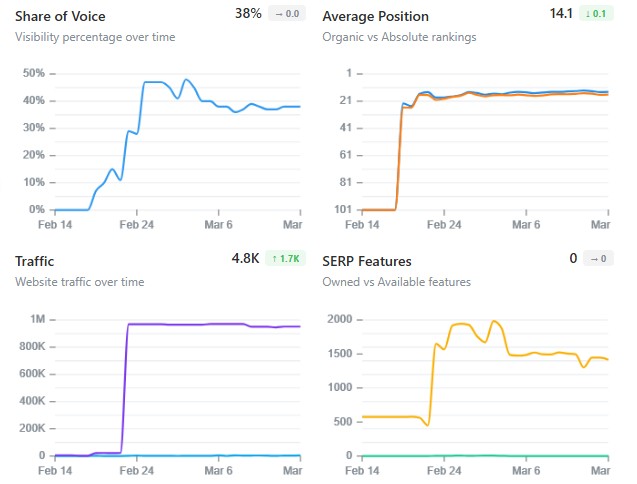
The point is not just to collect positions. It is to understand movement fast enough to make stronger SEO calls.
Follow individual terms closely so you can spot which rankings are steady, which are drifting, and which changes need a response.
See how each page performs across its tracked queries and identify where visibility is concentrated or fading.
Compare desktop and mobile positions and review location-based differences when rankings do not behave the same everywhere.
Turn ranking changes into useful action by focusing on pages, keywords, and position patterns that can influence results next.
A search engine rank tracker should help you answer a simple question quickly: where do your rankings stand right now, and how are they moving over time? For SEO professionals, marketers, agencies, founders, content teams, ecommerce businesses, publishers, and website owners, that question is rarely simple in practice. Rankings shift by keyword, page, location, device, and search result context. A term that looks stable on one report may be slipping on mobile. A page that appears healthy overall may be losing visibility on the exact queries that matter most. That is why a focused search engine ranking tracker is useful. It keeps attention on position changes, SERP placement, and page performance instead of pulling you into unrelated SEO noise.
The value of a dedicated keyword rank tracker is not just the ability to log positions. It is the ability to read movement clearly. When you track search engine rankings with the right level of detail, you can identify whether a gain is isolated or broad, whether a drop is tied to one landing page or several, and whether local results or device differences are changing the picture. That level of clarity helps teams move from raw ranking data to practical action. Instead of asking why traffic feels off, you can see whether a key page lost search visibility. Instead of wondering whether optimization work had an effect, you can review how rankings changed after updates went live.
A strong search engine rankings tracker should make it easy to monitor keyword rankings without turning the process into a reporting chore. Teams need to know which keywords moved, how far they moved, what page is ranking, and whether the shift happened on desktop, mobile, or in a specific location. They also need enough SERP rank tracker context to avoid misreading the numbers. A move from position three to position five means something different when the search results page changes shape, when local intent is involved, or when a page begins competing with another URL on the same site.
For agencies, this kind of visibility helps explain performance cleanly to clients. For in-house SEO teams, it supports prioritization. For founders and website owners, it reduces uncertainty around search performance. For content teams, it shows which pages are earning stronger placement and which topics may need refinement. For ecommerce teams, it helps highlight product and category pages that are slipping on valuable terms. A practical search position tracker supports all of these use cases because it stays centered on where rankings are, how they change, and what that means for the next decision.
Anyone can collect ranking snapshots. The harder part is understanding them. That is where a more focused Google rank tracker or broader search engine rank tracker becomes useful. Position data without context can lead to shallow decisions. A ranking drop may look urgent until you realize it only affected one device type. A page may appear to be underperforming until you see that it still owns the most important query cluster. A keyword may show improvement, but if the ranking URL changed unexpectedly, that movement deserves closer review.
When you monitor keyword rankings with context, you can separate noise from meaningful movement. You can review whether changes are isolated to a single page, spread across a topic set, or tied to a local market. You can compare mobile and desktop behavior to see whether user experience or result composition is influencing position. You can identify pages that rank for more terms than expected and pages that are fading across multiple queries. A search engine ranking tracker should make those patterns easier to see, not harder.
The best use of a keyword rank tracker is not passive reporting. It is decision support. If a page loses several positions across closely related terms, that may point to a content relevance issue. If rankings improve after an internal linking update, that may suggest the page is now easier for search engines to interpret. If local rankings differ sharply by market, it may indicate stronger regional competition or weaker location signals. Tracking is valuable because it creates a clearer line between what changed and what should happen next.
For that reason, a SERP rank tracker should help you review page-level ranking performance, not just keyword lists. Keywords matter, but pages are where optimization happens. When you can see which URL is associated with a cluster of terms, you gain a better understanding of where to update content, improve alignment, strengthen page intent, or resolve overlap between competing pages. That turns ranking data into something operational. Instead of reacting to every fluctuation, you can focus on the pages and terms where movement points to a real opportunity or risk.
Many teams monitor keyword rankings but still struggle to interpret performance because they do not look closely enough at the page behind the ranking. Page-level visibility matters because rankings are not independent from URL quality, relevance, structure, and intent. A page may hold several mid-page rankings that could become top-page rankings with focused improvements. Another page may rank for a wide set of terms but fail to gain stronger placement because the content does not fully match search intent. A search engine rankings tracker becomes more useful when it helps connect keyword movement to page behavior.
This is especially important for larger sites. Publishers, ecommerce stores, and content-heavy websites often have multiple pages touching similar topic areas. Without page-level review, it becomes easy to miss cannibalization, misaligned landing pages, or uneven performance across related content. A search engine rank tracker that highlights page performance gives teams a faster path to useful SEO action because it shows where rankings are concentrated, where they are unstable, and where a different page may be better positioned to earn visibility.
Search positions do not look the same everywhere. Local intent, mobile behavior, and result page differences can all influence visibility. That is why a practical search position tracker should support local and device-based checks as part of the ranking review process. A keyword that performs well on desktop may lag on mobile. A page that ranks strongly in one city may struggle in another. These differences matter because they affect how users actually encounter your site in search.
For local businesses, agencies with regional clients, and national brands with location-specific demand, local rank tracking helps reveal whether visibility is evenly distributed or concentrated in a few stronger markets. For mobile-heavy industries, device comparisons can uncover usability or intent alignment issues that standard reports might miss. A focused Google rank tracker approach is helpful here because it keeps the analysis anchored to search placement and ranking behavior rather than drifting into unrelated metrics. The goal is clarity around positions, not complexity for its own sake.
There is a balance between detail and usefulness. Teams need enough granularity to inspect keyword movement, but they also need a broader view of search performance. A good search engine rank tracker helps with both. It lets you monitor individual terms while also showing whether a page, category, content theme, or market is trending up or down. That combination matters because isolated rank checks can miss broader shifts, while high-level summaries can hide the exact keywords driving change.
For example, if several non-brand terms begin slipping across one product category, that may signal a competitive change or a relevance problem worth addressing. If a content hub gains rankings across long-tail queries but not head terms, that may suggest the page structure is improving but stronger authority or refinement is still needed. When you track search engine rankings in a way that combines keyword-level detail with page-level interpretation, you get a more useful understanding of search performance.
A keyword rank tracker should support real workflows. That means faster review of gains and drops, easier comparison across locations and devices, and stronger visibility into which pages are tied to which terms. It should help teams answer practical questions such as: Which pages lost the most important positions this week? Which keywords are close to breaking into stronger placements? Which URLs are gaining traction across a topic cluster? Which local markets need more attention? These are the questions that shape action.
That is the central value of a focused search engine rank tracker. It is not trying to be everything. It is designed to help teams understand ranking positions with less friction and more confidence. By keeping the emphasis on search engine rankings, position movement, SERP visibility, page performance, and practical next steps, it gives SEO teams and website owners a cleaner way to review what is happening in search and decide what to do about it.
Clear position tracking is most valuable when it shortens the distance between a ranking change and the decision that follows.
"We needed a cleaner way to monitor keyword rankings across a large content set. What stood out was how quickly we could see which pages were actually driving gains and which ones were quietly slipping."
"For client reporting, this made search position changes easier to explain. Instead of sending raw numbers, we could show movement, page impact, and where local differences were affecting visibility."
"Our content team uses it to see which pages are building traction and which keyword groups are flattening out. That helps us decide whether to refresh, expand, or leave a page alone."
"We wanted ranking visibility without a lot of unrelated SEO clutter. This kept the focus where we needed it: positions, movement, page performance, and practical next steps."
Simple answers for teams comparing rank tracking options and workflows.
A search engine rank tracker helps you see where your pages rank for chosen keywords and how those positions change over time.
The focus stays on rankings, keyword movement, SERP placement, page performance, and search position clarity rather than broad SEO toolsets.
Yes. You can monitor individual keywords, review movement history, and connect ranking changes to the pages behind them.
Yes. Page-level ranking data helps you see which URLs are gaining visibility, losing positions, or ranking for the wrong terms.
Because single snapshots miss the pattern. Ongoing tracking shows whether a page is improving, slipping, or staying stable.
Yes. Mobile and desktop search results can vary, so device-based checks help you understand visibility more accurately.
Yes. Local intent and regional competition can change positions, which is why location-based checks are useful.
It is useful for SEO professionals, marketers, agencies, founders, content teams, ecommerce teams, publishers, and website owners.
It should make ranking changes easy to read, connect keywords to pages, and help you decide what to update next.
Because a position number alone can be misleading. SERP context helps you understand what changed and how visible that ranking really is.
Technical guides, ranking strategies, and expert guest posts.
Average position is a blunt SEO metric that often hides the truth about your rankings. Learn why the math of averages can...
Search Engine Rank Tracker is built for one job: helping teams understand where their rankings stand and how those positions are changing. If you need a search engine rank tracker that keeps the focus on keyword movement, SERP visibility, page-level ranking performance, and practical SEO action, this is the right kind of starting point. The goal is not to bury ranking data under broad platform messaging. The goal is to make search position tracking easier to interpret and easier to use.
For SEO professionals and in-house marketers, ranking data becomes useful when it answers real questions. Which keywords gained? Which pages slipped? Did the change happen on mobile, desktop, or both? Is one market stronger than another? Has a page started ranking for the right terms, or is another URL taking over? A practical search engine ranking tracker should help you answer those questions quickly. That is the standard here.
There is a difference between collecting rankings and understanding them. A search engine rankings tracker should do more than store positions in a table. It should help you review movement patterns, connect keywords to landing pages, and spot the changes that deserve attention. When rankings rise, you want to know what likely contributed. When they fall, you want to know whether the issue is isolated, page-specific, location-specific, or broader across a topic area.
This is why focused rank tracking matters. It keeps your attention on the most relevant signals: position changes, page visibility, keyword group movement, local differences, and device-based variation. Instead of drifting into unrelated SEO categories, it stays anchored to the core problem teams are trying to solve every week: understanding search positions well enough to make the next decision with confidence.
Teams often struggle with ranking reviews because the raw data is fragmented. One report shows keyword positions. Another shows pages. Another shows mobile behavior. Another highlights local changes. Pulling those pieces together takes time, and the interpretation can still be fuzzy. A stronger search position tracker brings that view closer together so ranking movement becomes easier to read.
That matters for agencies managing multiple clients, founders watching search as a growth channel, publishers tracking editorial performance, ecommerce teams monitoring category and product visibility, and content teams deciding what to refresh next. Everyone needs a way to monitor keyword rankings without losing the context around those movements. When a ranking shift is clear, action becomes easier. When the picture is muddy, teams waste time debating what changed instead of improving what matters.
A keyword rank tracker is most useful when it does not stop at the keyword. Rankings happen through pages, and pages are where optimization work gets done. That is why page-level visibility matters. If one URL is gaining across a cluster of terms, that is useful. If another is slipping for high-intent queries, that matters too. A search engine rank tracker should help you see those relationships clearly so your updates are tied to the pages affecting search performance.
For content teams, that can mean identifying articles that are close to stronger positions and likely worth expanding. For ecommerce teams, it can mean finding category pages that are losing high-value rankings. For agencies, it can mean showing clients not only what moved, but which landing pages were responsible. For site owners, it reduces the guesswork around whether SEO work is actually changing visibility.
Position alone does not always tell the full story. A SERP rank tracker becomes more valuable when it helps you understand search placement in context. That includes how rankings vary by device, how local results change the picture, and how page-level performance connects to broader keyword trends. Seeing that context helps teams avoid shallow reactions to normal fluctuation and focus instead on meaningful changes.
That is especially useful when rankings do not move evenly. Sometimes one market weakens while another holds. Sometimes mobile slips before desktop does. Sometimes a page loses several adjacent terms at once, suggesting a stronger pattern. The point of tracking is to make those patterns visible. Once you can see them clearly, your SEO priorities become easier to set.
This approach is built for people who need ranking clarity more than software sprawl. SEO professionals can use it to monitor performance across keyword sets and landing pages. Agencies can use it to explain movement in a way clients can understand. Founders and operators can use it to keep a close eye on search visibility without wading through unnecessary complexity. Content teams can use it to evaluate which pages deserve updates. Ecommerce teams can use it to review category and product page positions across important terms. Publishers can use it to understand how editorial content is performing in search over time.
If your work depends on knowing where rankings stand, how they move, and what those movements suggest, a focused search engine ranking tracker is often more useful than a broader all-purpose SEO interface. It narrows the field of view to what actually helps: positions, movement, pages, local differences, device differences, and next-step clarity.
The best rank tracking workflow is not passive. It should help you decide whether to update a page, expand a topic cluster, improve intent alignment, compare device performance, or review local visibility. It should help you see whether a ranking change is minor noise or a sign of something worth acting on. It should make it easier to explain performance internally and easier to prioritize work with confidence.
That is the role of Search Engine Rank Tracker. It is a focused way to track, understand, and monitor search engine rankings with clearer visibility into movement, placement, page performance, and practical SEO action. If you want a search engine rank tracker that keeps the emphasis where it belongs, on understanding search positions well enough to improve them, this is the right place to begin.
From keyword tracking to search position review, every workflow is built around understanding where you rank, how positions shift, and what deserves attention next.
Track when AI Overviews appear, monitor brand and competitor citations,...
Track branded keywords across locations, devices, and SERP features to...
Track keyword rankings by city with Search Engine Rank Tracker....
Track competitor keyword positions, compare search visibility, spot ranking changes,...
Track your site against competing domains with a competitor rank...
Track keyword rankings by country to measure search visibility, monitor...
Get a clearer view of keyword positions, SERP placement, and page movement so your next SEO action is based on what is actually changing.